** For students starting A-Levels & their parents**
Strong GCSE results got them here. A new system will get them through A-Levels.
Help your child build GCSE confidence - without turning every evening into revision time.
A practical toolkit to help new Year 12 students study independently, use free periods well and start sixth form organised and confident from week one.
A-Levels aren't just harder GCSEs. There's more content, more depth and far less hand-holding. Students have to remember topics for two years, not two weeks, and nobody tells them what to do in their free periods.
That's why so many capable students reach October half term feeling behind, even though they're working hard.
Summer Bridge Plan · Weekly Study System · Printable templates · Parent Guide
Become the person who knows what to do when nobody is telling you what to do.
Strong GCSE results got them here. A new system will get them through A-Levels.
Strong GCSE results got them here. A new system will get them through A-Levels.
Summer Bridge Plan · Weekly Study System · Printable templates · Parent Guide
A practical toolkit to help new Year 12 students study independently, use free periods well and start sixth form organised and confident from week one.
A-Levels aren't just harder GCSEs. There's more content, more depth and far less hand-holding. Students have to remember topics for two years, not two weeks, and nobody tells them what to do in their free periods.
That's why so many capable students reach October half term feeling behind, even though they're working hard.
Become the person who knows what to do when nobody is telling you what to do.
THE SHIFT
Why good GCSE students often struggle at the start of A-Level
At GCSE, teachers set the pace, repeat key content and remind students what to revise.
Students could cram before a test and still do well. A-Level changes that at once.
More independence
Free periods appear, and there's nobody checking how they're used.
More depth
Understanding in the lesson isn't enough. Students have to apply ideas to questions they haven't seen before.
More to remember
Topics from September come up again in exams nearly two years later.
Higher demands in the answers
Exam wording, the level of precision and mark schemes are all stricter.
Does any of this sound familiar?
“I don't know what I'm meant to be doing in my free periods.”
“I understand it in class, then go blank in the test.”
“I got good GCSEs. Why does this feel so difficult?”
“I got good GCSEs. Why does this feel so difficult?”
“I got good GCSEs. Why does this feel so difficult?”
And as a parent, you may be wondering how to help a nearly-adult child without checking up on them, especially in subjects you may never have studied.
The problem usually isn't ability. It's that nobody has shown them how A-Level study actually works.
THE SHIFT
Why good GCSE students often struggle at the start of A-Level
At GCSE, teachers set the pace, repeat key content and remind students what to revise.
Students could cram before a test and still do well. A-Level changes that at once.
More independence
Free periods appear, and there's nobody checking how they're used.
More depth
Understanding in the lesson isn't enough. Students have to apply ideas to questions they haven't seen before.
More to remember
Topics from September come up again in exams nearly two years later.
Higher demands in the answers
Exam wording, the level of precision and mark schemes are all stricter.
Does any of this sound familiar?
“I don't know what I'm meant to be doing in my free periods.”
“I understand it in class, then go blank in the test.”
And as a parent, you may be wondering how to help a nearly-adult child without checking up on them, especially in subjects you may never have studied.
“I got good GCSEs. Why does this feel so difficult?”
“I got good GCSEs. Why does this feel so difficult?”
“I got good GCSEs. Why does this feel so difficult?”
The problem usually isn't ability. It's that nobody has shown them how A-Level study actually works.
THE SOLUTION
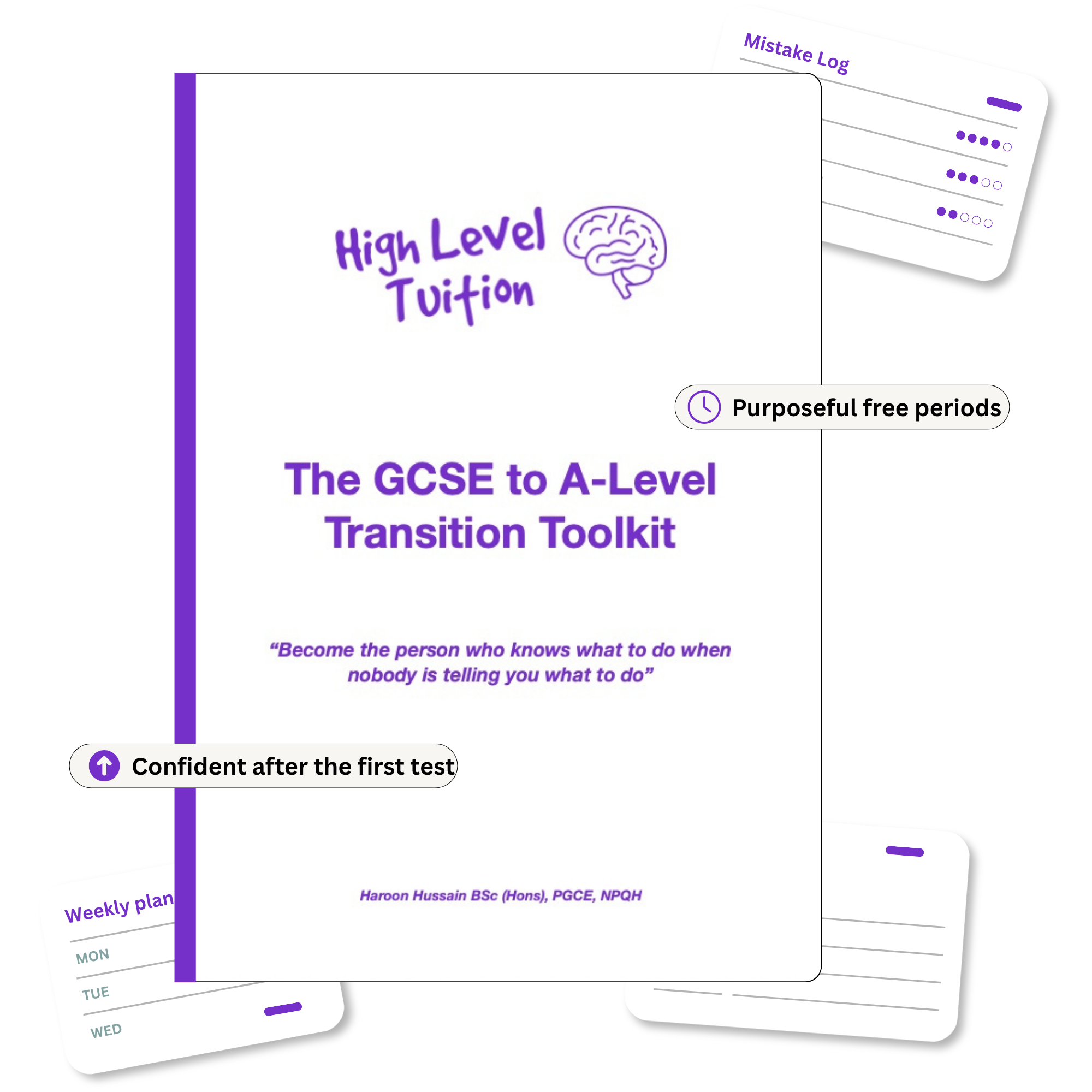
Meet the GCSE to A-Level Transition Toolkit
A practical system for starting Year 12 organised, independent and confident.
This isn't a subject textbook or a list of generic study tips. It's a step-by-step guide to the habits A-Level students need: preparing well, planning each week, studying actively and recovering quickly when something goes wrong.
01 What should I do before September?
02 What should I do in each free period?
03 How do I study so I still remember it months later?
04 What do I do when a test goes badly?
05 When should I ask for help, and how?
WHAT'S INSIDE
Everything they need to make the jump from GCSE
01
The Summer Bridge Plan
Prepare properly in 6–8 focused sessions, without losing the whole summer.
Result: They arrive in September ready to learn, not playing catch-up.
02
Close GCSE gaps without re-revising everything
Find the GCSE topics A-Level content builds on, and fix only the ones that matter.
Result: Shaky foundations don't hold them back.
03
The Weekly Study System
Plan a realistic week around lessons, homework, part-time work, friends and rest.
Result: Steady progress instead of bursts of panic.
04
Free periods with a clear job
Study-Period Cards give each free period one specific task.
Result: Free periods become their most productive time.
05
Study methods that last
Same-day consolidation, retrieval practice, spaced review and regular exam questions.
Result: They still know the material months later.
06
The Mistake Log
Work out whether each lost mark came from knowledge, application, technique or exam language.
Result: They fix the actual cause.
07
The First-Term Recovery Plan
A step-by-step response to a disappointing first assessment.
Result: A dip in early grades leads to a better plan, not a loss of confidence.
08
The Confidence Tracker
Track every topic across both years.
Result: Final-exam revision starts from a clear map.
09
The Parent Guide
Support independence without nagging or checking their timetable.
Result: More useful support, with less tension.
CHAOS TO CONTROL
From overwhelmed to in control
STARTING A-LEVEL FEELING...
WITH THE TOOLKIT, THEY CAN...
“Free periods just disappear.”
Give every study period a clear job.
“I reread my notes but forget them.”
Use methods that make learning stick.
“One bad test and I panic.”
Diagnose the problem, fix it and improve.
“I'm always catching up.”
Follow a weekly routine they can keep up.
“I don't know if I'm ready.”
Arrive in September already prepared.
“I want to help, but not nag.”(parent)
Use a calm, structured weekly check-in.
THE TEMPLATES
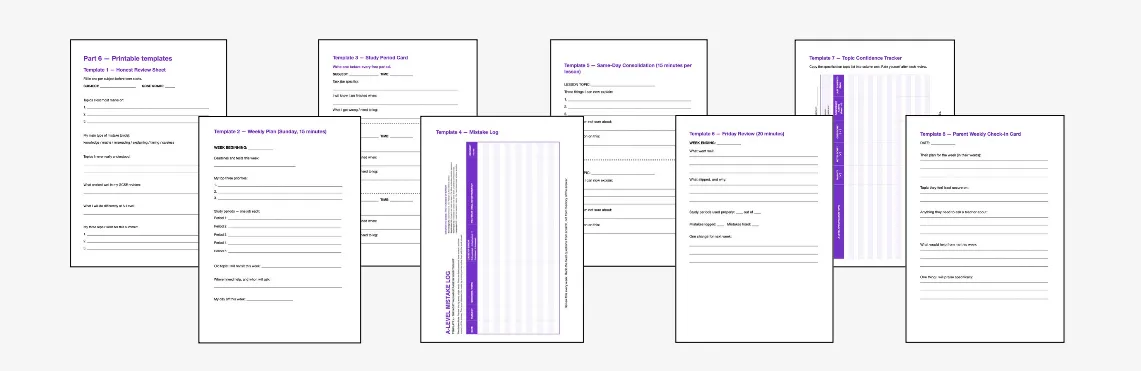
More than advice.
Tools they can use from day one.
Weekly plan
STUDY PERIOD CARD
Mistake log
CONFIDENCE tracker
Parent check-in
INCLUDED PRINTABLES
Honest Review Sheet
Weekly Plan
Study Period Cards
Mistake Log
Same-Day Consolidation
Friday Review
Topic Confidence Tracker
Parent Weekly Check-in Card
PLUS:
Summer Bridge Plan
The 10 Rules for Starting A-Level
THE TEMPLATES
More than advice.
Tools they can use from day one.
Weekly plan
STUDY PERIOD CARD
Mistake log
CONFIDENCE tracker
Parent check-in
INCLUDED PRINTABLES
Honest Review Sheet
Weekly Plan
Study Period Cards
Mistake Log
Same-Day Consolidation
Friday Review
Topic Confidence Tracker
Parent Weekly Check-in Card
PLUS:
Summer Bridge Planner
Summer Bridge Planner
The 10 Rules on one page
THE TEMPLATES
More than advice.
Tools they can use from day one.
Weekly plan
STUDY PERIOD CARD
Mistake log
CONFIDENCE tracker
Parent check-in
INCLUDED PRINTABLES
Honest Review Sheet
Weekly Plan
Study Period Cards
Mistake Log
Same-Day Consolidation
Confidence Tracker
Parent Weekly Check-in Card
The 10 Rules for Starting A-Level
HOW IT WORKS
A simple system they can start now
01
Bridge
Complete the Summer Bridge Plan and fix key GCSE gaps.
02
Plan
Set out the week each Sunday and give every free period a task.
03
Consolidate
Review each important lesson the same day.
04
Practise
Retrieval, spaced review and exam questions every week.
05
Diagnose
Log mistakes, find the cause and redo the questions later.
06
Review
Check progress each week, adjust the plan and ask for help early.
A strong Year 12 isn't built in one perfect week. It's built by repeating focused, ordinary habits.
The Parent Guide
Your role is changing, but it still matters.
At A-Level, checking homework stops working. Your child needs to own their learning. They still benefit from someone in their corner who is calm, encouraging and ready to help with the practical side.
The Parent Guide helps you move from supervising to coaching.
You don't need to understand the subjects. The guide gives you the structure; you provide the calm and the belief.
INSTEAD OF
“Have you done your work?”
TRY
“What are your free periods for this week?”
INSTEAD OF
Reacting to a low first grade
TRY
“What did the test show, and what's the plan?”
INSTEAD OF
Measuring effort in hours
TRY
Checking whether they can explain a topic without notes.
Already feeling behind? This still helps.
Whether you're preparing in the summer or reading this in October, the toolkit works from wherever you are.
They don't need to
Start again
Work every evening
Give up their social life
They need to
Find the topics holding them back
Give free periods specific jobs
Ask for help within days
Fix GCSE foundations
Learn from every test
Small gaps in October are easy to fix. Waiting until the mocks makes everything harder.
The 10 Rules for Starting A-Level
1
Prepare before September, not after the first test.
2
Fix GCSE gaps that A-Level builds on.
3
Give every free period one clear job.
4
Review each lesson the same day.
5
Test yourself; don't just reread.
6
Return to old topics regularly.
7
Do exam questions every week.
8
Log every mistake and find its cause.
9
If you're stuck, ask for help that week.
10
Protect rest. A routine you can keep beats one that burns you out.
Already feeling behind?
This still helps.
Whether you're preparing in the summer or reading this in October, the toolkit works from wherever you are.
They don't need to
Start again
Work every evening
Give up their social life
They need to
Find the topics holding them back
Give free periods specific jobs
Ask for help within days
Fix GCSE foundations
Learn from every test
Small gaps in October are easy to fix. Waiting until the mocks makes everything harder.
The 10 Rules for Starting A-Level
1
Prepare before September, not after the first test.
2
Fix GCSE gaps that A-Level builds on.
3
Give every free period one clear job.
4
Review each lesson the same day.
5
Test yourself; don't just reread.
6
Return to old topics regularly.
7
Do exam questions every week.
8
Log every mistake and find its cause.
9
If you're stuck, ask for help that week.
10
Protect rest. A routine you can keep beats one that burns you out.

Created by Haroon Hussain, BSc (Hons), PGCE, NPQH — Specialist GCSE Chemistry educator and programme designer.
Designed for real students, living in the real world with real exam pressure.
"A practical approach to helping students organise their study, check their understanding and learn from mistakes."
FAQ
Questions parents ask
Is it subject-specific?
No. It's a study system that works across A-Level subjects. It covers planning, study methods, error analysis and routines, not subject content.
It's already term time. Is it too late?
No. Skip the summer section and start with the weekly system and an audit of GCSE gaps.
My child got strong GCSEs. Do they need this?
Often, yes. High achievers are often the students most caught out when cramming stops working.
Will it take over their life?
No. It's built around purposeful free periods and short daily consolidation, with rest protected.
What do I get, and how does it arrive?
Straight after you pay, you'll receive a confirmation email and a link to your Quick Start page. That page has the toolkit download (a digital guide with printable templates you can print as often as you need), your first steps and a short welcome video. Your Guided Implementation Emails start the same day and take you through the toolkit one step at a time.
Does it guarantee grades?
No. It provides a clear structure. Results depend on how consistently it's used.
Does my child need to buy anything else?
No. It works alongside their school or college lessons. If one subject is still a struggle after the first few weeks, the first step is their subject teacher; the toolkit shows them how to ask for help in a way that gets a useful answer.
FAQ
Questions parents ask
Is it subject-specific?
No. It's a study system that works across A-Level subjects. It covers planning, study methods, error analysis and routines, not subject content..
It's already term time. Is it too late?
No. Skip the summer section and start with the weekly system and an audit of GCSE gaps.
My child got strong GCSEs. Do they need this?
Often, yes. High achievers are often the students most caught out when cramming stops working.
Will it take over their life?
No. It's built around purposeful free periods and short daily consolidation, with rest protected.
What format is it?
The toolkit is a digital file which contains printable templates which can be printed off at home as often as needed
Does it guarantee grades?
No. It provides a clear structure. Results depend on how consistently it's used.
Does my child need to buy anything else?
No. It works alongside their school or college lessons. If one subject is still a struggle after the first few weeks, the first step is their subject teacher; the toolkit shows them how to ask for help in a way that gets a useful answer
FAQ
Questions parents ask
Is it subject-specific?
No. It's a study system that works across A-Level subjects. It covers planning, study methods, error analysis and routines, not subject content..
It's already term time. Is it too late?
No. Skip the summer section and start with the weekly system and an audit of GCSE gaps.
My child got strong GCSEs. Do they need this?
Often, yes. High achievers are often the students most caught out when cramming stops working.
Will it take over their life?
No. It's built around purposeful free periods and short daily consolidation, with rest protected.
What do I get, and how does it arrive?
Straight after you pay, you'll receive a confirmation email and a link to your Quick Start page. That page has the toolkit download (a digital guide with printable templates you can print as often as you need), your first steps and a short welcome video. Your Guided Implementation Emails start the same day and take you through the toolkit one step at a time.
Does it guarantee grades?
No. It provides a clear structure. Results depend on how consistently it's used.
Does my child need to buy anything else?
No. It works alongside their school or college lessons. If one subject is still a struggle after the first few weeks, the first step is their subject teacher; the toolkit shows them how to ask for help in a way that gets a useful answer
Don't wait for the first bad test to find out GCSE habits aren't enough.
Give your child a clear plan for the biggest academic step they've taken so far: how to prepare, how to use their time and what to do when things get hard.
The Summer Bridge Plan
Evidence-based study methods
Printable planning and tracking templates
The Weekly Study System
The Mistake Log and First-Term Recovery Plan
A dedicated Parent Guide
Start Year 12 with a system, not stress.
What happens after you buy
1. Instant access. Your Quick Start page, toolkit download and a short welcome video from Haroon.
2. Choose your route. Summer before Year 12, or already in term. Your emails adjust to match.
3. Emails for you and your child. Parent emails show you how to support without checking up. Your child can get their own matching emails, which gradually hand the system over to them.
Only
£30
GCSE to A-Level Transition Toolkit
£30 · one-off payment · instant digital access
Where this fits in
Part of a four-stage system:
Year 9 choose and practise → Year 10 build the habits → Year 11 run the system → Year 12 run it independently.

This site is not a part of the Facebook website or Facebook Inc. Additionally, This site is NOT endorsed by Facebook in any way. FACEBOOK is a trademark of FACEBOOK, Inc.
Important: Legal Disclaimers
Results depend on how consistently the toolkit is used. We don't promise specific grades, but we do promise a clear, practical plan and honest guidance.
© Copyright 2026 - High Level Tuition - All Rights Reserved
Terms of Use | Privacy Policy | support: [email protected]