Practical study toolkits · Year 9 to Year 12
The right support for their next stage.
One simple study system that grows with your child, from GCSE options in Year 9 to independent study in Year 12. Each toolkit gives your child clear weekly steps and gives you a calm way to support them, without needing to teach any subject yourself.
| ✔ Created by a qualified teacher and school leader | ✔ £30 per toolkit | ✔ Instant digital access |
✔ Guided emails included |
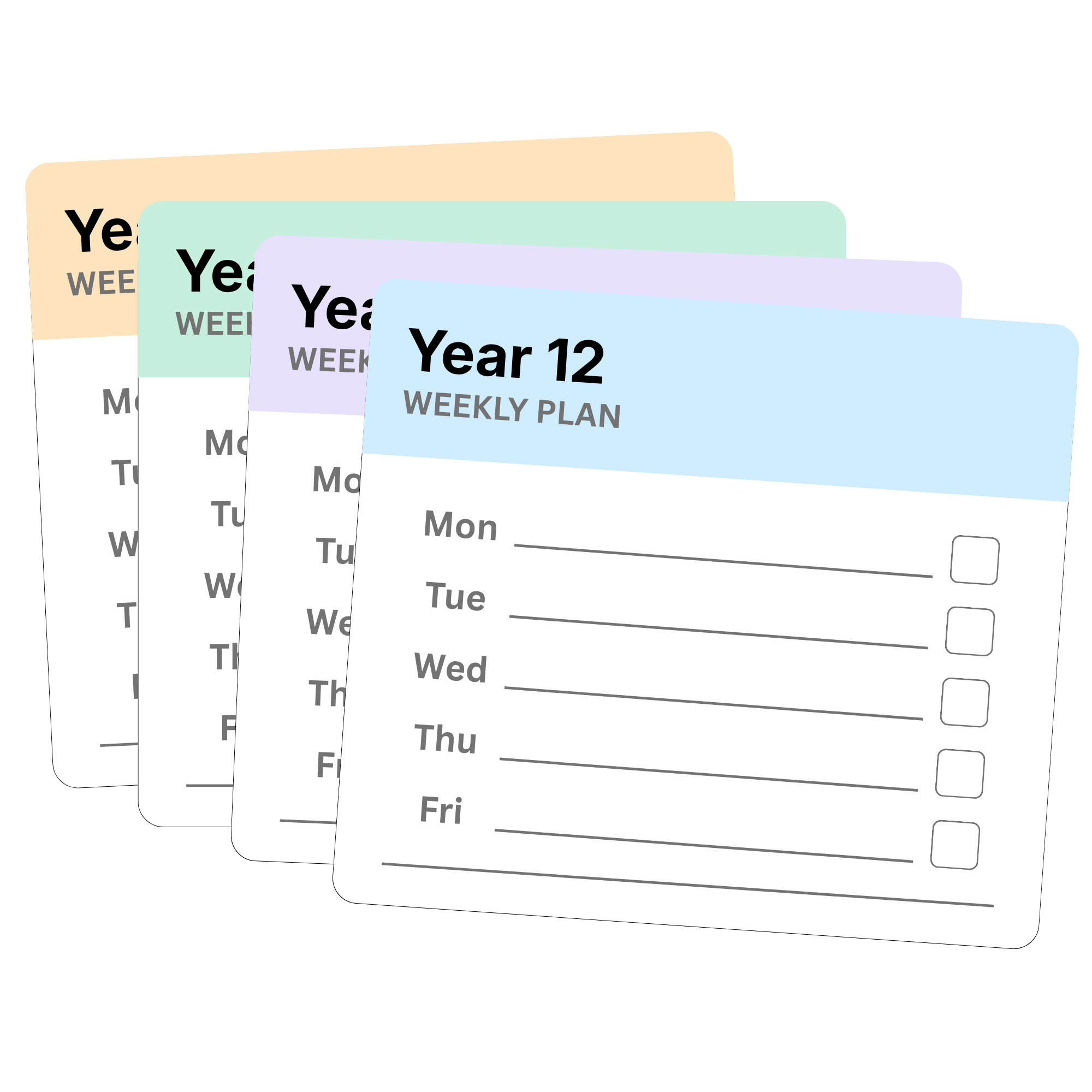
Practical study toolkits · Year 9 to Year 12
The right support for their next stage.
One simple study system that grows with your child, from GCSE options in Year 9 to independent study in Year 12. Each toolkit gives your child clear weekly steps and gives you a calm way to support them, without needing to teach any subject yourself.
| ✔ Created by a qualified teacher and school leader | ✔ £30 per toolkit | ✔ Instant digital access | ✔ Guided emails included |
Practical study toolkits · Year 9 to Year 12
The right support for their next stage.
One simple study system that grows with your child, from GCSE options in Year 9 to independent study in Year 12. Each toolkit gives your child clear weekly steps and gives you a calm way to support them, without needing to teach any subject yourself.
| ✔ Created by a qualified teacher and school leader
| ✔ £30 per toolkit
| ✔ Instant digital access
|✔ Guided emails included
Which toolkit, and do they need one?
A 3-minute guide for parents
Haroon explains what each toolkit does, how the years build on each other, and how to tell whether your child needs a toolkit, tuition or neither yet
Which toolkit, and do they need one?
A 3-minute guide for parents
Haroon explains what each toolkit does, how the years build on each other, and how to tell whether your child needs a toolkit, tuition or neither yet
What year is your child in?
Start with their current school year. If they're about to move up, use the timing guide below.
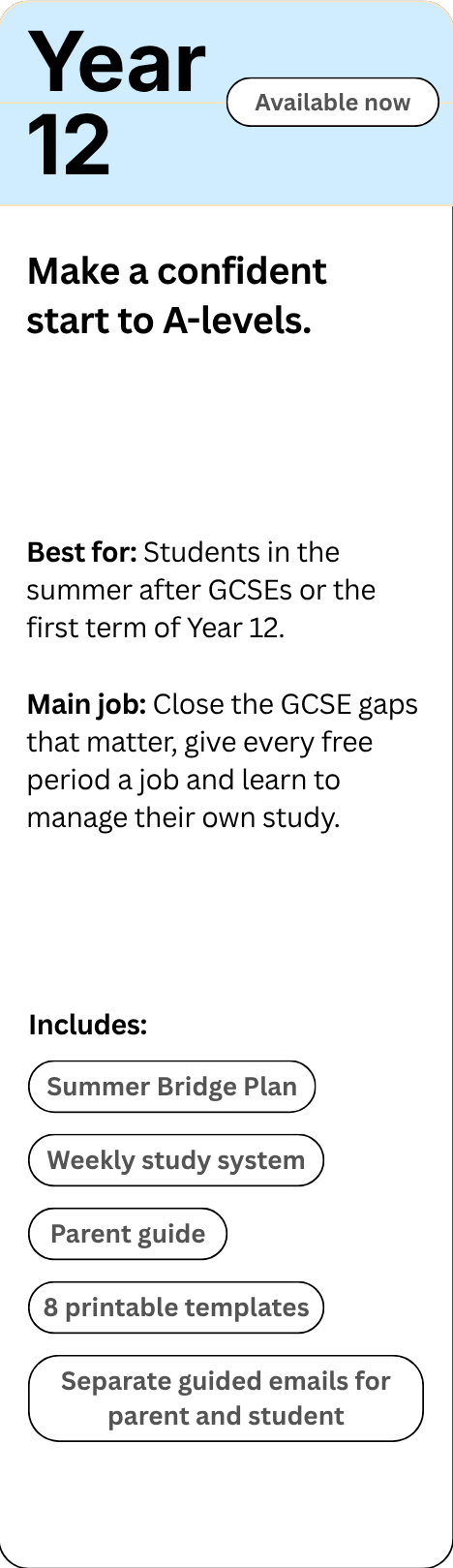
What year is your child in?
Start with their current school year. If they're about to move up, use the timing guide below.
What year is your child in?
Start with their current school year. If they're about to move up, use the timing guide below.
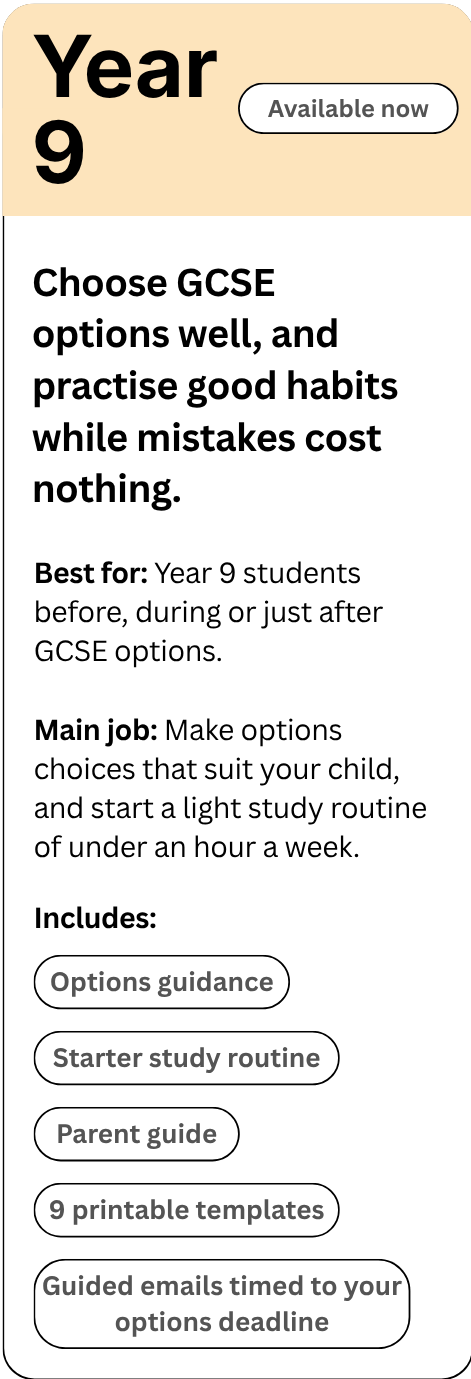
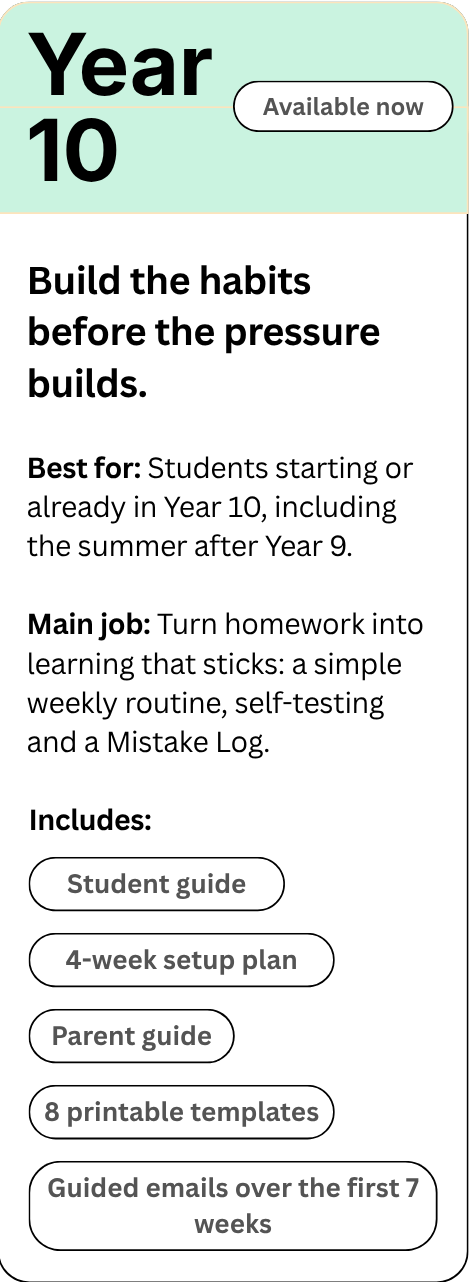
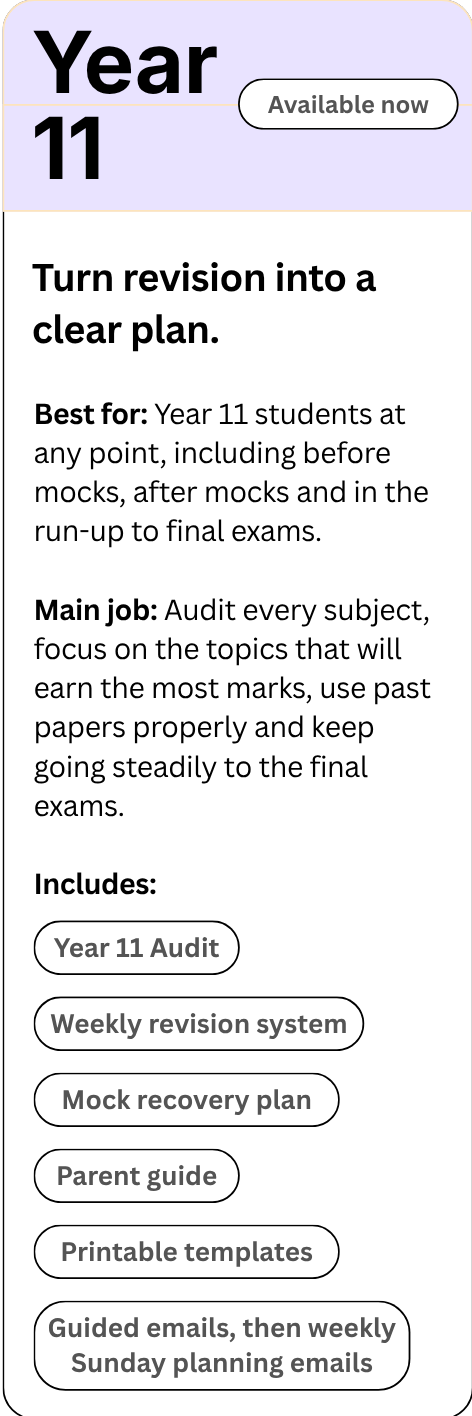
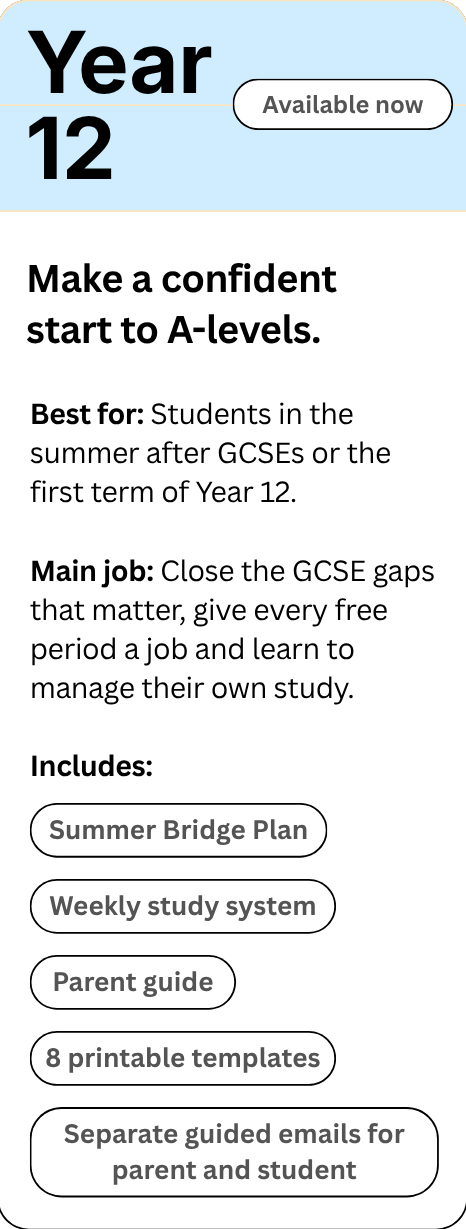
Between years? Here's which toolkit to choose.
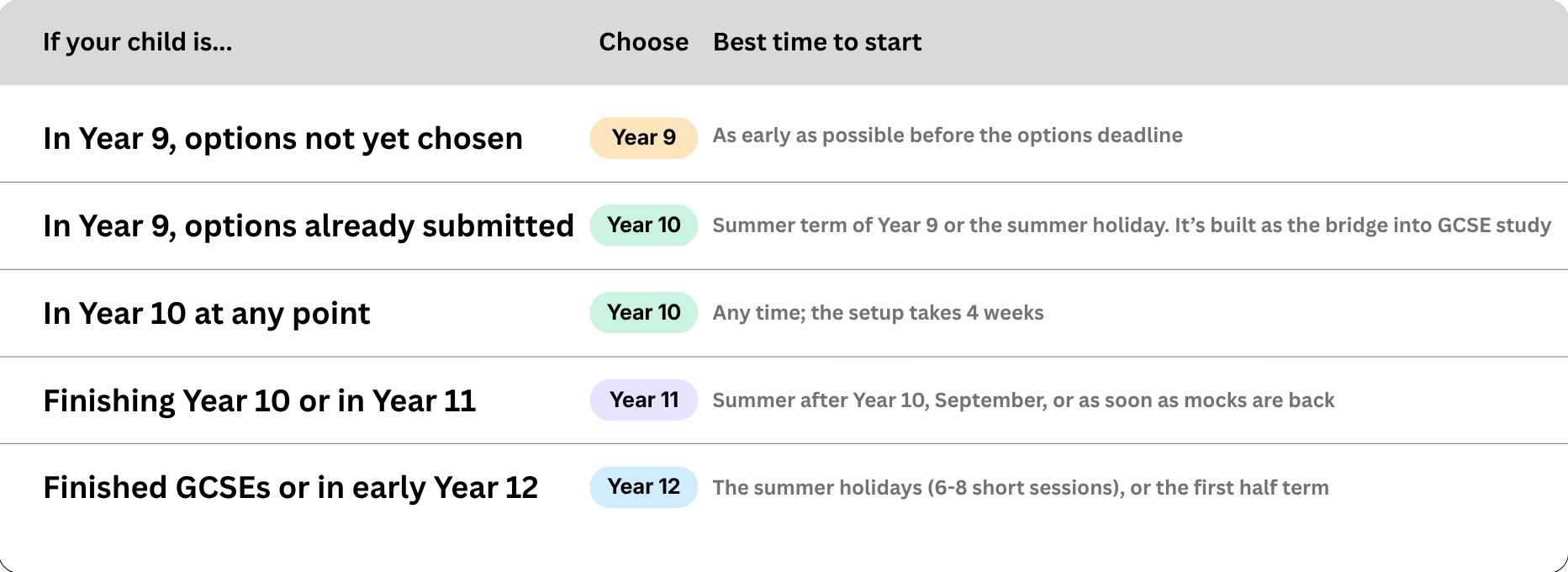
Still unsure? Choose their current year. Each toolkit starts by finding out where your child actually is, so it works whenever you start.
Between years? Here's which toolkit to choose.
Still unsure? Choose their current year. Each toolkit starts by finding out where your child actually is, so it works whenever you start.
Between years? Here's which toolkit to choose.
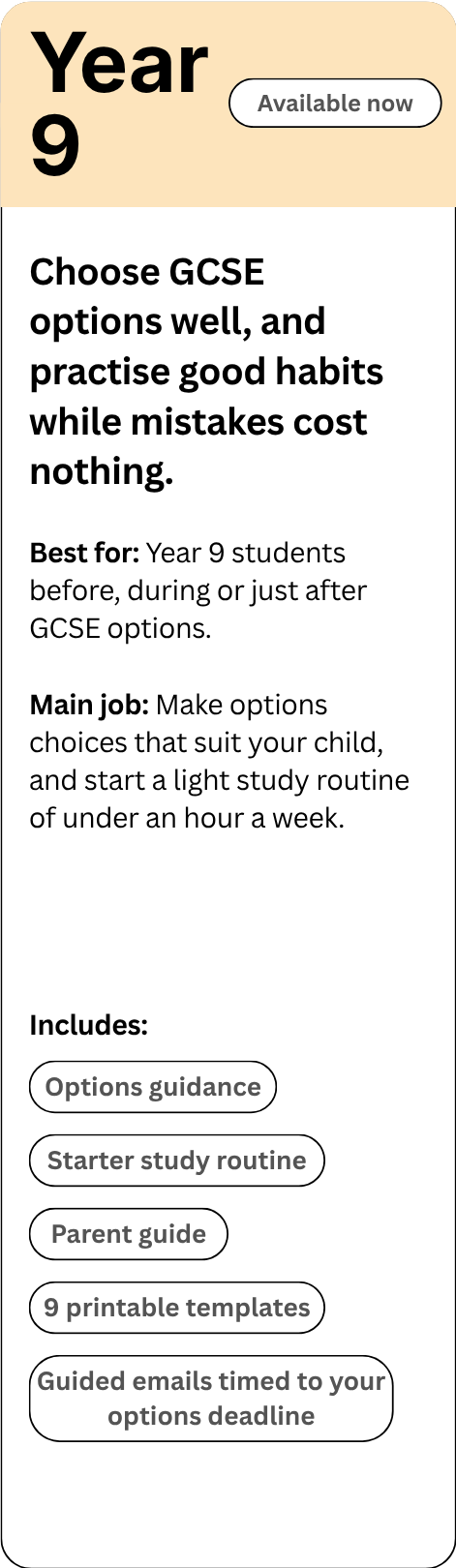
In Year 9, options not yet chosen
As early as possible before the options deadline
In Year 9, options already submitted
Summer term of Year 9 or the summer holiday. It's built as the bridge into GCSE study
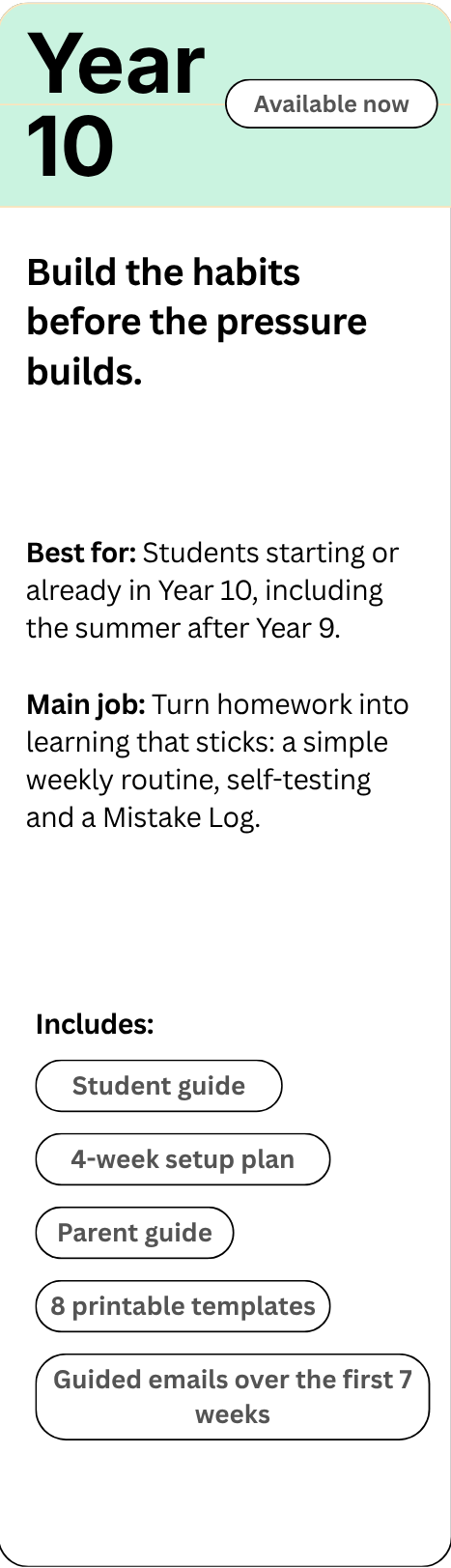
In Year 10 at any point
Any time; the setup takes four weeks
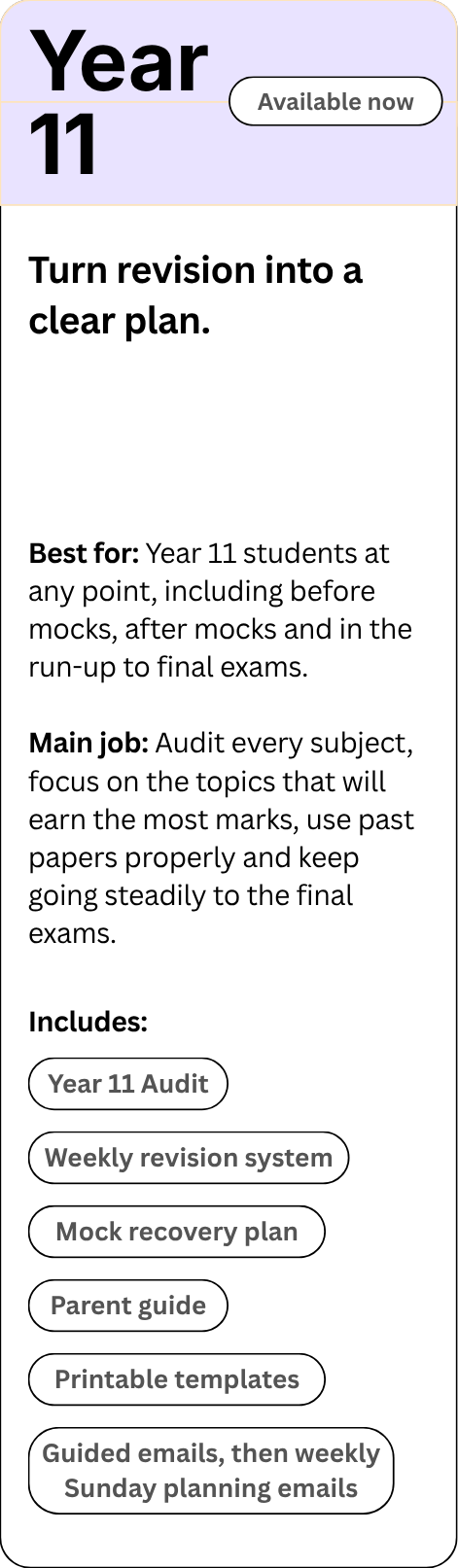
Finishing Year 10 or in Year 11
Summer after Year 10, September, or as soon as mocks are back
Finished GCSEs or in early Year 12
The summer holiday (6–8 short sessions), or the first half term
Still unsure? Choose their current year. Each toolkit starts by finding out where your child actually is, so it works whenever you start.
One system that grows with your child.
Every toolkit uses the same four core tools: a Weekly Plan, a Mistake Log, a Friday Check and a Parent Check-In. Each year adds what that stage needs. Children who start early don't have to learn a new system later. They just add to the one they have.
Weekly Plan
Mistake Log
Friday Check
Parent Check-In
Year 9 – Choose and practise
Choose options carefully. Try a short weekly routine while nothing counts yet.
ADDS:
Subject Explorer
Options Decision Grid
Year 10 – Build the habits
Make learning stick: self-testing, tracking topics, fixing mistakes early.
ADDS:
Honest Start Sheet
Topic Tracker
Year 11 – Run the system
Audit every subject, focus on the right topics, use past papers well and learn from mocks.
ADDS:
Subject Audit
Past Paper Record
Mock Analysis
Countdown Planner
Year 12 – Run it independently
Same habits, much more independence. Your child takes charge and you step back.
ADDS:
Summer Bridge Plan
Study Period Cards
Self Management Review
YOUR ROLE CHANGES TOO
Guiding (Year 9) ➡ Checking in (Years 10–11) ➡ Handing over (Year 12)
One system that grows with your child.
Every toolkit uses the same four core tools: a Weekly Plan, a Mistake Log, a Friday Check and a Parent Check-In. Each year adds what that stage needs. Children who start early don't have to learn a new system later. They just add to the one they have.
Weekly Plan
Mistake Log
Friday Check
Parent Check-In
Year 9 – Choose and practise
Choose options carefully. Try a short weekly routine while nothing counts yet.
ADDS:
Subject Explorer
Options Decision Grid
Year 10 – Build the habits
Make learning stick: self-testing, tracking topics, fixing mistakes early.
ADDS:
Honest Start Sheet
Topic Tracker
Year 11 – Run the system
Audit every subject, focus on the right topics, use past papers well and learn from mocks.
ADDS:
Subject Audit
Past Paper Record
Mock Analysis
Countdown Planner
Year 12 – Run it independently
Same habits, much more independence. Your child takes charge and you step back.
ADDS:
Summer Bridge Plan
Study Period Cards
Self Management Review
YOUR ROLE CHANGES TOO
Guiding (Year 9) ➡
Checking in (Years 10–11) ➡
Handing over (Year 12)
More than a PDF. A plan you'll actually use.
The toolkit guide
Short, step-by-step and written for students, with a dedicated section for parents.
Printable templates
Print as many copies as you need, all year.
A Quick Start page
The first steps to take, plus a short welcome video from Haroon.
Guided implementation emails
Short emails that take you through the toolkit one step at a time over the first six to seven weeks, so it gets used rather than left in a downloads folder. Year 12 families get separate emails for the parent and the student.
A one-off £30 payment
No subscription.
More than a PDF.
A plan you'll actually use.
The toolkit guide
Short, step-by-step and written for students, with a dedicated section for parents.
Printable templates
Print as many copies as you need, all year.
A Quick Start page
The first steps to take, plus a short welcome video from Haroon.
Guided implementation emails
Short emails that take you through the toolkit one step at a time over the first six to seven weeks, so it gets used rather than left in a downloads folder. Year 12 families get separate emails for the parent and the student.
A one-off £30 payment
No subscription.
Toolkit, tuition, or neither yet?
As a tutor, I'll be honest: many children don't need tuition. They need a clear routine and a way to see what's working. Start with the system. If one subject is still stuck after a few weeks, that's the time to think about extra help.
Start with a toolkit if…
✔ Your child isn't sure what to study, or how
✔ The problems show up across several subjects, not just one
✔ Revision causes arguments, or happens only the night before
✔ They haven't yet followed a steady routine for four to six weeks
Consider tuition if…
✔ They've followed a routine for four to six weeks, and one subject is still not improving
✔ The Mistake Log keeps showing the same type of mistake in that subject
✔ Their teacher confirms there are gaps in core understanding, not just revision habits
✔ The exam is close and the gap is large
Often the best answer is both: a toolkit to run the week, and focused help in the one subject that needs it. The toolkit's Topic Tracker and Mistake Log also make any tutor's time far more useful.
Year 11 GCSE Chemistry?
I teach AQA Higher GCSE Chemistry using my Foundations First approach. If Chemistry is the subject still stuck after the routine, you can watch a free training video and apply for a consultation.

Created by Haroon Hussain,
BSc (Hons), PGCE, NPQH
Teacher, school leader and specialist GCSE Chemistry educator. I built these toolkits because I kept seeing capable students work hard without a system, and parents who wanted to help but didn't know where to start.
The aim is simple: help families move from 'I don't know what to do next' to a calm, structured routine that works at home.
Questions parents ask
Which toolkit should I choose?
Start with your child's current school year. If they're about to move up, use the timing guide above. Each toolkit starts with a short review of where your child is, so it works whenever you start.
Is it for my child or me?
Both. The main guide is written for your child, in short, direct steps. There's a dedicated parent section and a weekly check-in card, so you can support them without teaching or nagging.
Does it teach subject content?
No, and that's deliberate. School teaches the content. The toolkit teaches your child how to study it: what to work on, how to practise, how to learn from mistakes, and what to do next.
How much time does it take?
Year 9 starts at under an hour a week on top of homework. Years 10 and 11 use short, focused study slots built around school and family life. Year 12 starts with 6–8 summer sessions, then a weekly routine. None of them use 12-hour revision timetables.
We're halfway through the year. Is it too late?
No. Each toolkit begins by finding where your child is now. The Year 11 Toolkit includes a plan for students who feel behind or have had a disappointing mock.
Will it replace tuition?
For many families, yes, because the issue was the system, not the subject. If one subject is still stuck after four to six weeks of steady use, see 'Toolkit, tuition, or neither yet?' above.
I have more than one child. Do I need more than one toolkit?
Each toolkit is written for one stage, so children in different years need their own. The core tools are the same, which makes running two at home easier.
What do I get, and how does it arrive?
Straight after you pay, you'll receive a confirmation email and a link to your Quick Start page. That page has the toolkit download (a digital guide with printable templates you can print as often as you need), your first steps and a short welcome video. Your Guided Implementation Emails start the same day and take you through the toolkit one step at a time.

This site is not a part of the Facebook website or Facebook Inc. Additionally, This site is NOT endorsed by Facebook in any way. FACEBOOK is a trademark of FACEBOOK, Inc.
Important: Legal Disclaimers
Results depend on how consistently the toolkit is used. We don't promise specific grades, but we do promise a clear, practical plan and honest guidance.
© Copyright 2026 - High Level Tuition - All Rights Reserved
Terms of Use | Privacy Policy | Support: [email protected]