** FOR YEAR 9 STUDENTS AND PARENTS **
Help your child choose the right GCSE options—and build the study habits that make Year 10 and 11 easier.
Help your child build GCSE confidence - without turning every evening into revision time.
A simple, practical toolkit for the year that matters more than most families realise.
Year 9 is not an exam year. Nobody is asking your child to revise for hours. That is exactly why it is such a good chance.
This year they make choices that shape the next two years. They can also practise the habits they will need at GCSE while mistakes still cost nothing.
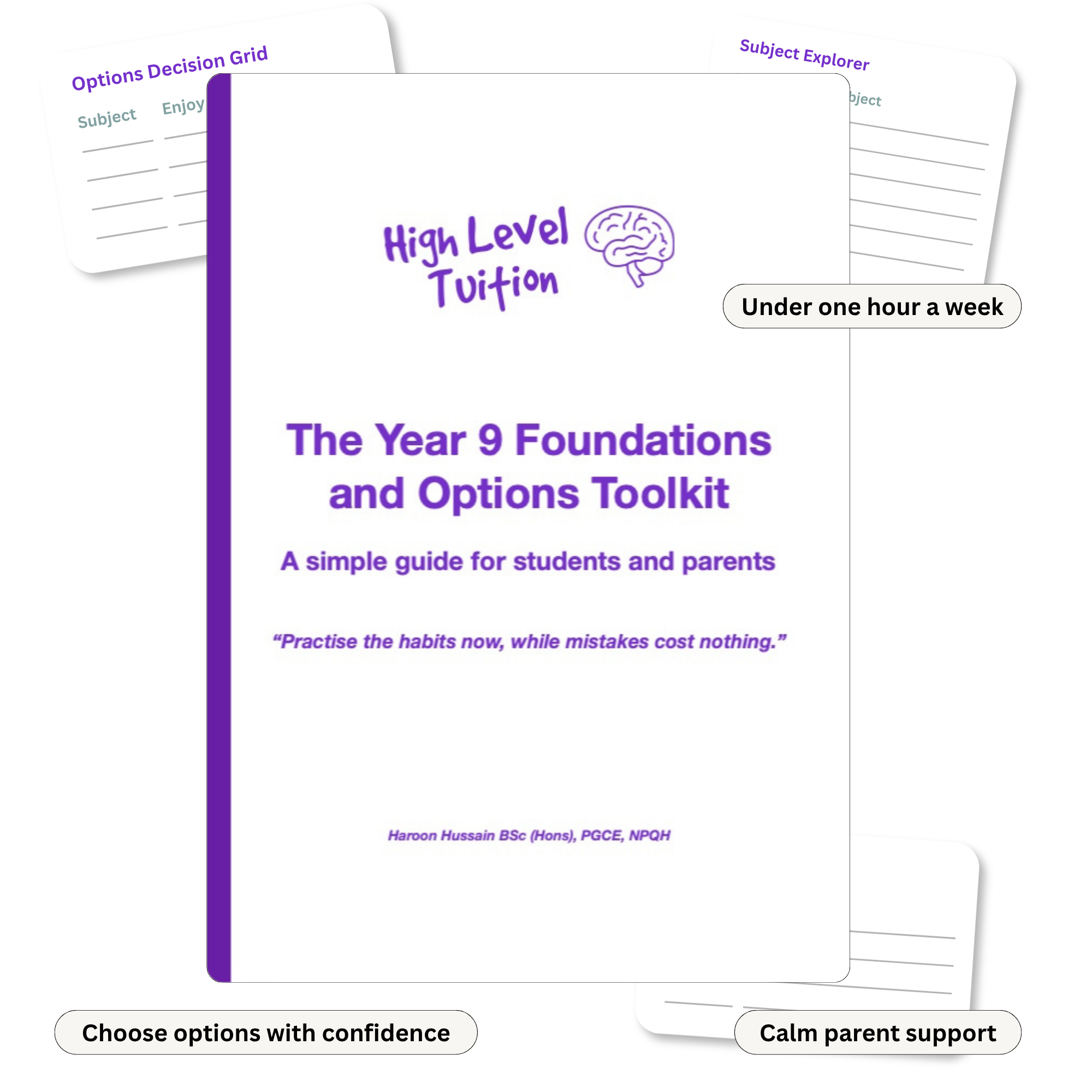
The Year 9 Foundations and Options Toolkit helps you get both right, calmly and together.
Options guidance | Starter study routine | Parent Guide | Nine printable templates
“Practise the habits now, while mistakes cost nothing.”
Help your child choose the right GCSE options—and build the study habits that make Year 10 and 11 easier.
Help your child choose the right GCSE options—and build the study habits that make Year 10 and 11 easier.
Options guidance | Starter study routine | Parent Guide | Nine printable templates
A simple, practical toolkit for the year that matters more than most families realise.
Year 9 is not an exam year. Nobody is asking your child to revise for hours. That is exactly why it is such a good chance.
This year they make choices that shape the next two years. They can also practise the habits they will need at GCSE while mistakes still cost nothing.
The Year 9 Foundations and Options Toolkit helps you get both right, calmly and together.
“Practise the habits now, while mistakes cost nothing.”
Options evening is coming. Do you both know how to decide?
Options already chosen? Use Year 9 to build the habits.
For many families, Year 9 goes like this:
01
The options booklet comes home and gets skimmed.
02
Your child leans towards the subjects their friends are taking, or the teacher they like.
03
They have no idea what job they want, so every choice feels like a guess.
04
You are not sure whether Triple or Combined Science matters, or which subjects keep doors open.
05
Meanwhile, the way they study stays the same: rereading notes, revising the night before and forgetting it after the test.
Most students then reach Year 11 and have to learn how to study at the same time as learning everything else, under pressure.
It does not have to work that way.
Year 9 gives your child time to choose carefully and to practise good habits before anything counts.
For parents, it provides a shared structure for supporting this process without needing to teach every subject.
For parents, it provides a shared structure for supporting this process without needing to teach every subject.
Options evening is coming.
Do you both know how to decide?
Options already chosen? Use Year 9 to build the habits.
For many families, Year 9 goes like this:
01
The options booklet comes home and gets skimmed.
02
Your child leans towards the subjects their friends are taking, or the teacher they like.
03
They have no idea what job they want, so every choice feels like a guess.
04
You are not sure whether Triple or Combined Science matters, or which subjects keep doors open.
05
Meanwhile, the way they study stays the same: rereading notes, revising the night before and forgetting it after the test.
Most students then reach Year 11 and have to learn how to study at the same time as learning everything else, under pressure.
It does not have to work that way.
Year 9 gives your child time to choose carefully and to practise good habits before anything counts.
For parents, it provides a shared structure for supporting this process without needing to teach every subject.
Two jobs. One simple toolkit.
01
Choose GCSE options well
A clear, step-by-step way to explore subjects, ask the right questions and make a choice that makes sense to your child, not just to their friends.
02
Build study habits early
A small starter routine of under one hour a week on top of homework, designed so studying feels normal by Year 10.
Not hours of extra revision. Not deciding their whole future at 14.
For parents, it provides a shared structure for supporting this process without needing to teach every subject.
For parents, it provides a shared structure for supporting this process without needing to teach every subject.
Two jobs. One simple toolkit.
01
Choose GCSE options well
A clear, step-by-step way to explore subjects, ask the right questions and make a choice that makes sense to your child, not just to their friends.
02
Build study habits early
A small starter routine of under one hour a week on top of homework, designed so studying feels normal by Year 10.
Not hours of extra revision. Not deciding their whole future at 14.
Not hours of extra revision.
Not deciding their whole future at 14.
For parents, it provides a shared structure for supporting this process without needing to teach every subject.
Two jobs.
One simple toolkit.
01
Choose GCSE options well
A clear, step-by-step way to explore subjects, ask the right questions and make a choice that makes sense to your child, not just to their friends.
02
Build study habits early
A small starter routine of under one hour a week on top of homework, designed so studying feels normal by Year 10.
Not hours of extra revision. Not deciding their whole future at 14.
For parents, it provides a shared structure for supporting this process without needing to teach every subject.
Not hours of extra revision.
Not deciding their whole future at 14.
Choose for their future, not their friends.
Four good reasons to choose a subject
They enjoy it
They are improving at it
It helps a future path
It balances their mix
The best choices tick at least two.
Reasons to be careful of
Friends are taking it
They like the teacher
It looks easy
Someone else told them to
No idea what they want to do? That's normal.
A balanced mix keeps doors open: core subjects, a humanity, a language or creative subject, and one subject they really enjoy.
Core Subjects
Humanity
Language or creative
One they love
Already have a goal?
Medicine, dentistry, vet or pharmacy:
Do well in all sciences and maths. Most medical schools ask for A-Level Chemistry, and many ask for Biology too, so Triple Science is a good choice if you enjoy science.
Also covers engineering, law and business, creative careers and apprenticeships, plus a plain-English guide to A-Levels, T-Levels and apprenticeships.
Up to date with recent changes
Schools are no longer judged on the EBacc, and the government wants every student who could benefit from Triple Science to have the chance to take it. The toolkit explains what this means for your child's choices.
A thought-through decision, made together, before the deadline.
Practise the habits now, while mistakes cost nothing.
SUNDAY
Sunday Plan
5 minutes to check what's on this week.
AFTER LESSONS
Same-Day Catch-Up
5 minutes after a tricky lesson.
TWO SLOTS
Two Study Slots
20 minutes each, with one clear job.
FRIDAY
Friday Check
5 minutes to review what went well and where help is needed.
Under one hour a week, with weekends kept for rest, sport and friends.
Learn in a way that sticks
Blank-page tests, flashcards, practice questions, and returning to topics after a day, a week and a month.
Turn mistakes into progress
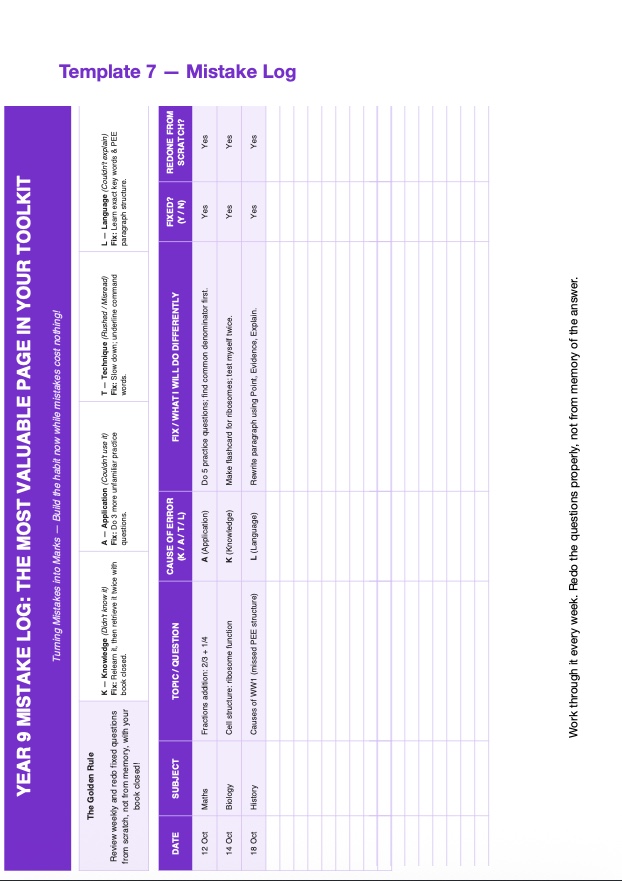
A Mistake Log that sorts every error into Knowledge, Application, Technique or Language, with a clear fix for each.
Strengthen five foundation skills
Reading, number skills, key words, clear paragraph writing and following instructions.
Practise the habits now, while mistakes cost nothing.
SUNDAY
Sunday Plan
5 minutes to check what's on this week.
AFTER LESSONS
Same-Day Catch-Up
5 minutes after a tricky lesson.
TWO SLOTS
Two Study Slots
20 minutes each, with one clear job.
FRIDAY
Friday Check
5 minutes to review what went well and where help is needed.
Under one hour a week, with weekends kept for rest, sport and friends.
Learn in a way that sticks
Blank-page tests, flashcards, practice questions, and returning to topics after a day, a week and a month.

Turn mistakes into progress
A Mistake Log that sorts every error into Knowledge, Application, Technique or Language, with a clear fix for each.
Strengthen five foundation skills
Reading, number skills, key words, clear paragraph writing and following instructions.
A clear plan for the whole year.
AUTUMN
Set up and explore
Get organised, start the routine, begin daily reading, start filling in Subject Explorers.
SPRING
Choose your options
Options evening, teacher conversations, Decision Grid, hand in before the deadline.
SUMMER
Practise for GCSE
Treat end-of-year exams as a practice run, fill in the Mistake Log, fix the weakest skill.
Tools you can print and use this week.
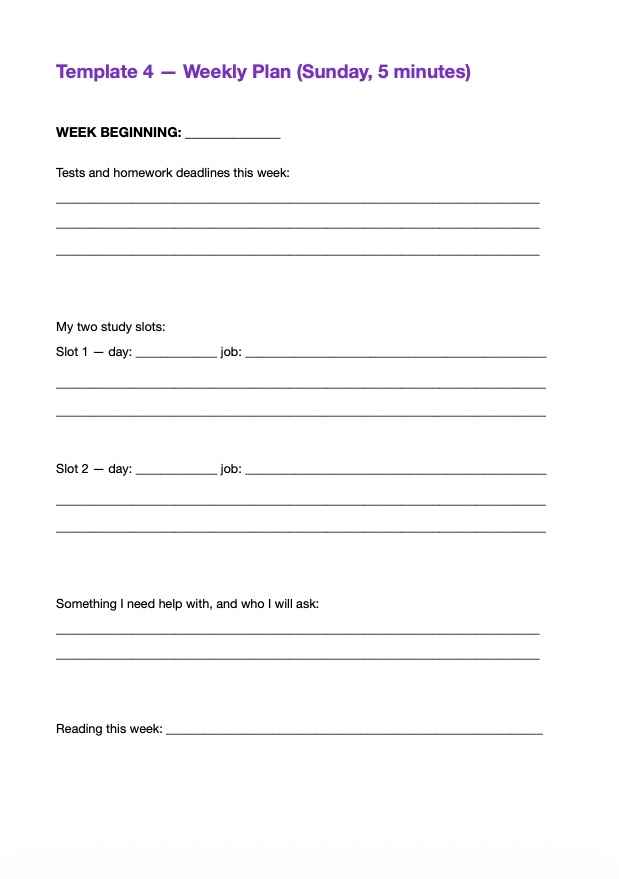
All nine templates
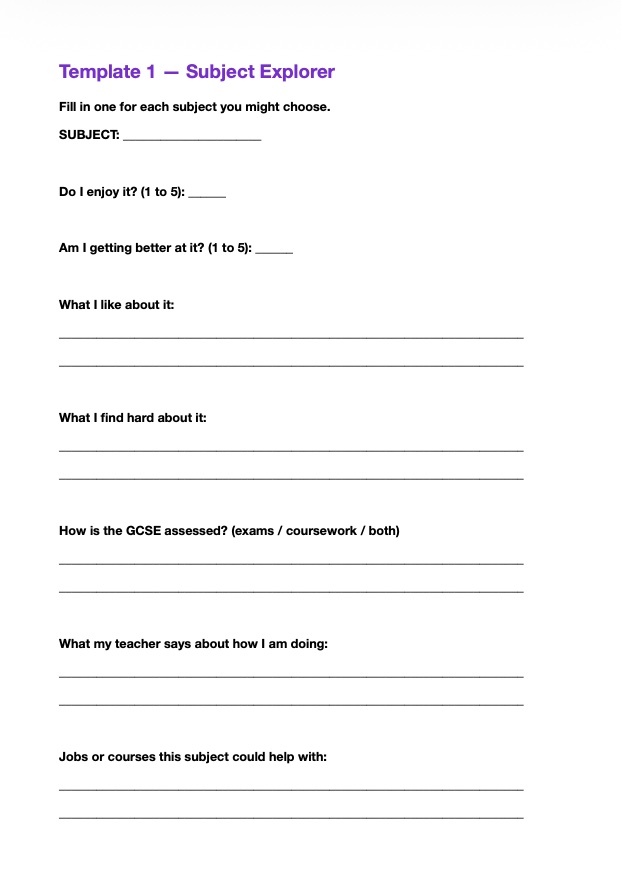
01 Subject Explorer
04 Weekly Plan
07 Mistake Log
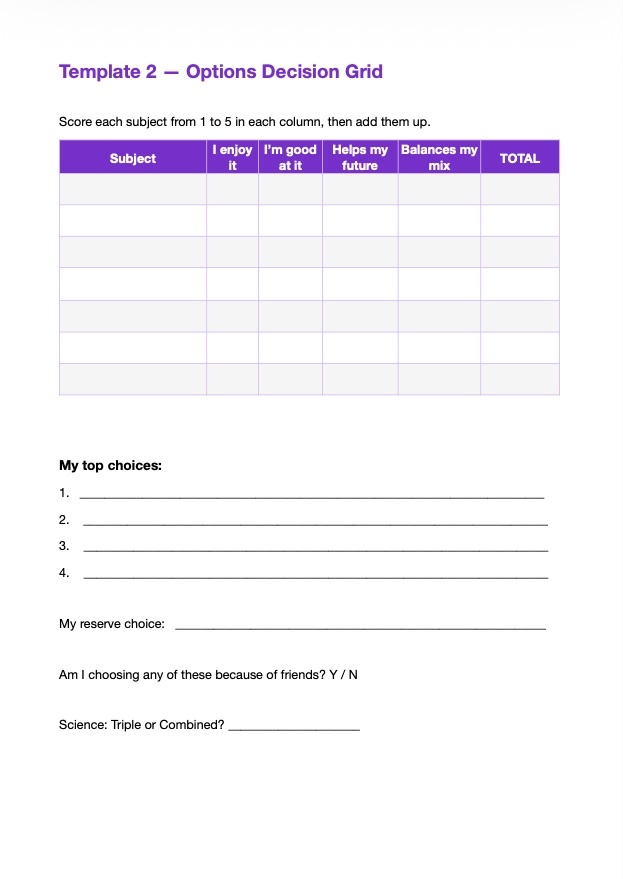
02 Options Decision Grid
05 Study Slot Card
08 Friday Check
03 Questions for Options Evening
06 Same Day Catch-Up
09 Parent Check-in Card
01 Honest Start Sheet
05 Same Day Catch-Up Sheet
02 Weekly Plan
06 Friday Check
03 Study Slot Card
07 Topic Tracker
04 Mistake Log
08 Parent Check-In Card
Tools you can print and use this week.
All nine templates
01 Subject Explorer
04 Weekly Plan
07 Mistake Log
02 Options Decision Grid
05 Study Slot Card
08 Friday Check
03 Questions for Options Evening
06 Same Day Catch-up
09 Parent Check-in Card
01 Subject Explorer
04 Weekly Plan
07 Mistake Log
02 Options Decision Grid
05 Study Slot Cards
08 Friday Check
03 Questions for Options Evening
06 Same Day Catch-Up
09 Parent Check-in Card
Tools you can print and use this week.
All nine templates
01 Subject Explorer
02 Options Decision Grid
03 Questions for Options Evening
04 Weekly Plan
05 Study Slot Card
06 Same Day Catch-Up
07 Mistake Log
08 Friday Check
09 Parent Check-in Card
01 Honest Start Sheet
05 Same Day Catch-Up Sheet
02 Weekly Plan
06 Friday Check
03 Study Slot Card
07 Topic Tracker
04 Mistake Log
08 Parent Check-In Card
FOR PARENTS
You don't need to know the subjects. You need the right questions.
At 13 or 14, your child still needs structure from you. The Parent Guide shows you how to provide it without choosing for them or nagging.
“Which subjects do you actually enjoy?”
“Are you choosing this because you want to, or because of friends?”
“If one choice is full, what is your reserve?”
Also included
Questions to ask teachers at options evening
A weekly 5-minute chat
A “this helps / this backfires” guide to phones, sleep, reading and results
How to praise effort
Warning signs that mean it's time to talk to school
A family agreement you complete together
“I believe in you. Let's build good habits now, so the next two years feel calm.”
A useful next step if…
A useful next step if…
Options decisions are coming up and you want a clear process.
Your child doesn't know what they want to do yet.
They're tempted to follow friends.
They revise by rereading and forget it after the test.
You want to help without daily battles.
You'd rather build habits now than scramble in Year 11.
This is an options and study-habits toolkit, not a replacement for lessons or school careers advice. Always check your school's own options booklet.
A useful next step if…
A useful next step if…
Options decisions are coming up and you want a clear process.
Your child doesn't know what they want to do yet.
They're tempted to follow friends.
They revise by rereading and forget it after the test.
You want to help without daily battles.
You'd rather build habits now than scramble in Year 11.
This is an options and study-habits toolkit, not a replacement for lessons or school careers advice. Always check your school's own options booklet.

Created by Haroon Hussain, BSc (Hons), PGCE, NPQH — Specialist GCSE Chemistry educator and programme designer.
Designed for real students and families, living in the real world
"A practical approach to helping students pick the best options, and build the foundations for strong study habits"
Created by Haroon Hussain, BSc (Hons), PGCE, NPQH — Specialist GCSE Chemistry educator and programme designer.
Designed for real students and families, living in the real world
"A practical approach to helping students pick the best options, and build the foundations for strong study habits"
Questions parents ask
When should we start?
Ideally in the autumn term, before options evening. It still works if options are close, because the Subject Explorer and Decision Grid can be completed in a weekend.
Will it tell my child which subjects to pick?
No. It gives them a clear way to decide, so the choice makes sense to them. Always check your school's own options booklet.
Has the EBacc gone? Does that change what my child should take?
Schools are no longer judged on the EBacc, a set of subjects (English, maths, science, a language, and history or geography) that some schools used to push students towards. Those subjects still count in how schools are measured, so they remain valued, but schools may now give more flexibility. A balanced mix is still the safest way to keep doors open.
Can my child take Triple Science?
The government has said that every student who could benefit from Triple Science should have the chance to take it. This is being introduced over time, so ask your school what it offers now.
My child wants to study medicine. What should they choose?
Do well in all sciences and maths. Most medical schools ask for A-Level Chemistry, and many ask for Biology too, so Triple Science is a good choice if they enjoy science. Requirements vary, so check individual medical schools later on.
Is this a lot of extra work?
No. The starter routine is under one hour a week on top of homework.
What happens after Year 9?
The same core tools (Weekly Plan, Mistake Log, Friday Check and Parent Check-In) carry straight into the Year 10 GCSE Foundations Toolkit, so your child builds on what they already know rather than starting again.
Does it guarantee results?
No. It gives a structure for choosing well and studying effectively.
What do I get, and how does it arrrive?
Straight after you pay, you'll receive a confirmation email and a link to your Quick Start page. That page has the toolkit download (a digital guide with printable templates you can print as often as you need), your first steps and a short welcome video. Your Guided Implementation Emails start the same day and take you through the toolkit one step at a time.
Questions parents ask
When should we start?
Ideally in the autumn term, before options evening. It still works if options are close, because the Subject Explorer and Decision Grid can be completed in a weekend.
Will it tell my child which subjects to pick?
No. It gives them a clear way to decide, so the choice makes sense to them. Always check your school's own options booklet.
Has the EBacc gone? Does that change what my child should take?
Schools are no longer judged on the EBacc, a set of subjects (English, maths, science, a language, and history or geography) that some schools used to push students towards. Those subjects still count in how schools are measured, so they remain valued, but schools may now give more flexibility. A balanced mix is still the safest way to keep doors open.
Can my child take Triple Science?
The government has said that every student who could benefit from Triple Science should have the chance to take it. This is being introduced over time, so ask your school what it offers now.
My child wants to study medicine. What should they choose?
Do well in all sciences and maths. Most medical schools ask for A-Level Chemistry, and many ask for Biology too, so Triple Science is a good choice if they enjoy science. Requirements vary, so check individual medical schools later on.
Is this a lot of extra work?
No. The starter routine is under one hour a week on top of homework.
What happens after Year 9?
The same core tools (Weekly Plan, Mistake Log, Friday Check and Parent Check-In) carry straight into the Year 10 GCSE Foundations Toolkit, so your child builds on what they already know rather than starting again.
Does it guarantee results?
No. It gives a structure for choosing well and studying effectively.
What do I get, and how does it arrive?
Straight after you pay, you'll receive a confirmation email and a link to your Quick Start page. That page has the toolkit download (a digital guide with printable templates you can print as often as you need), your first steps and a short welcome video. Your Guided Implementation Emails start the same day and take you through the toolkit one step at a time.
Year 9 is the practice year. Make it count.
Good choices now. Small habits now. A calmer Year 10 and 11 later.
Step-by-step options guidance, including recent EBacc and Triple Science changes
Starter study routine (under one hour a week)
Learning methods, Mistake Log and foundation-skill fixes
Term-by-term Year 9 plan
Dedicated Parent Guide
Nine printable templates
What happens after you buy
1. Instant access. Your Quick Start page, toolkit download and a short welcome video from Haroon.
2. Tell us your options deadline. Your first email asks one question, then times everything to your school's dates, whether the deadline is months away or this week.
3. Guided Implementation Emails. Short emails take you through the Subject Explorer, the Decision Grid and the starter routine, one step at a time.
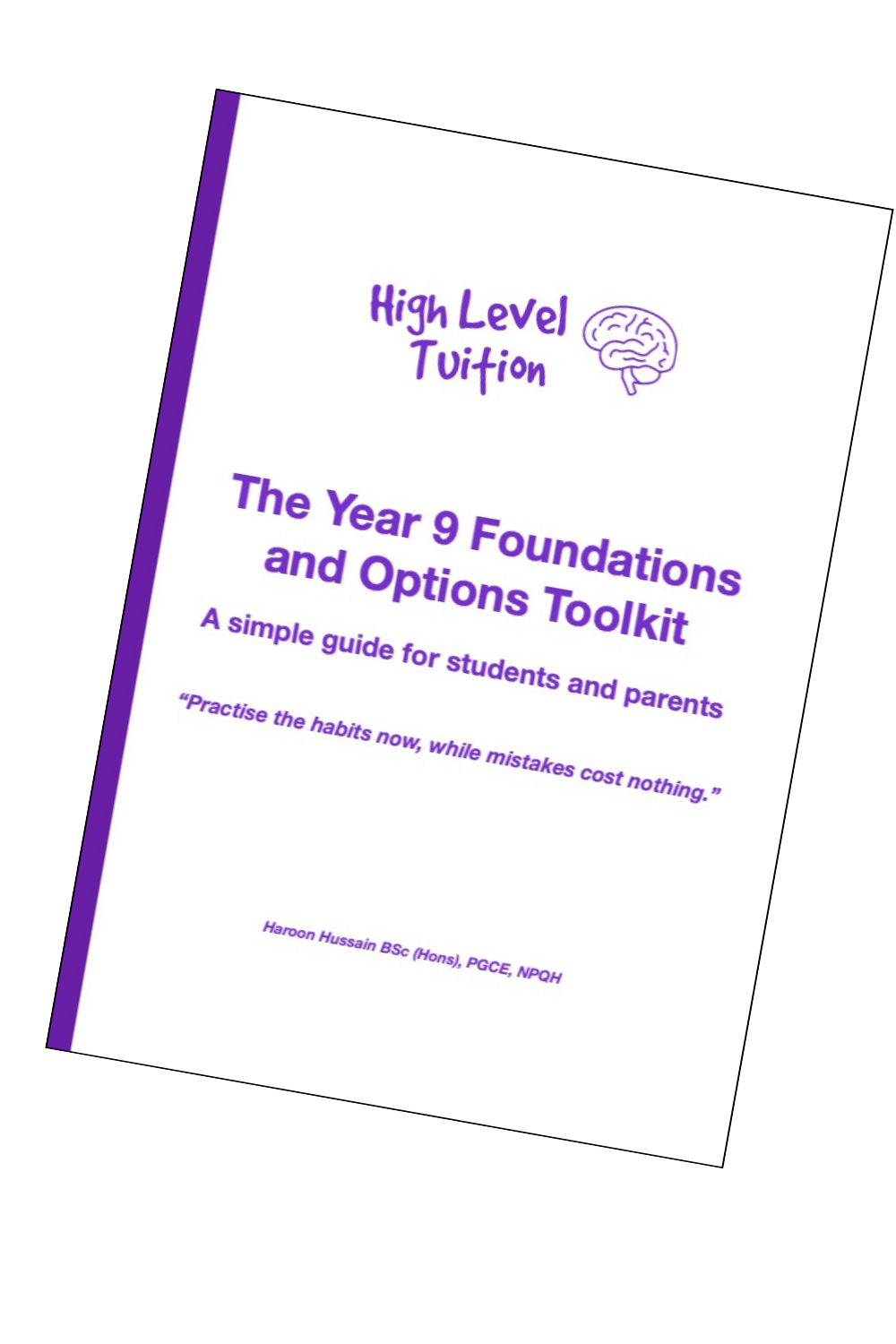
Only
£30
Year 9 Foundations and Options Toolkit
£30 · one-off payment · instant digital access
Practise the habits now, while mistakes cost nothing.
Year 9 is the practice year. Make it count.
Good choices now. Small habits now. A calmer Year 10 and 11 later.
Step-by-step options guidance, including recent EBacc and Triple Science changes
Starter study routine (under one hour a week)
Learning methods, Mistake Log and foundation-skill fixes
Term-by-term Year 9 plan
Dedicated Parent Guide
Nine printable templates
What happens after you buy
1. Instant access. Your Quick Start page, toolkit download and a short welcome video from Haroon.
2. Tell us your options deadline. Your first email asks one question, then times everything to your school's dates, whether the deadline is months away or this week.
3. Guided Implementation Emails. Short emails take you through the Subject Explorer, the Decision Grid and the starter routine, one step at a time.
Only
£30
Year 9 Foundations and Options Toolkit
£30 · one-off payment · instant digital access
Practise the habits now, while mistakes cost nothing.
Where this fits
Part of a four-stage system:
Year 9 choose and practise → Year 10 build the habits → Year 11 run the system → Year 12 run it independently.
See all toolkits ➡

This site is not a part of the Facebook website or Facebook Inc. Additionally, This site is NOT endorsed by Facebook in any way. FACEBOOK is a trademark of FACEBOOK, Inc.
Important: Legal Disclaimers
Results depend on how consistently the toolkit is used. We don't promise specific grades, but we do promise a clear, practical plan and honest guidance.
© Copyright 2026 - High Level Tuition - All Rights Reserved
Terms of Use | Privacy Policy | Support: [email protected]