** FOR YEAR 10 STUDENTS & PARENTS **
Help your child build GCSE confidence - without turning every evening into revision time.
Help your child build GCSE confidence - without turning every evening into revision time.
A practical toolkit to help Year 10 students get organised, remember what they learn and know what to study next.
You want your child to take their GCSEs seriously.
But you do not want the next two years to become a cycle of reminders, rushed revision and arguments about whether they have done enough.
The Year 10 GCSE Foundations Toolkit gives you both a clearer way forward: small, purposeful study habits, practical planning tools and a calm approach to supporting them at home.
Student guide | Eight printable templates | Dedicated parent guidance
Build the habits now. Give Year 11 a stronger starting point.
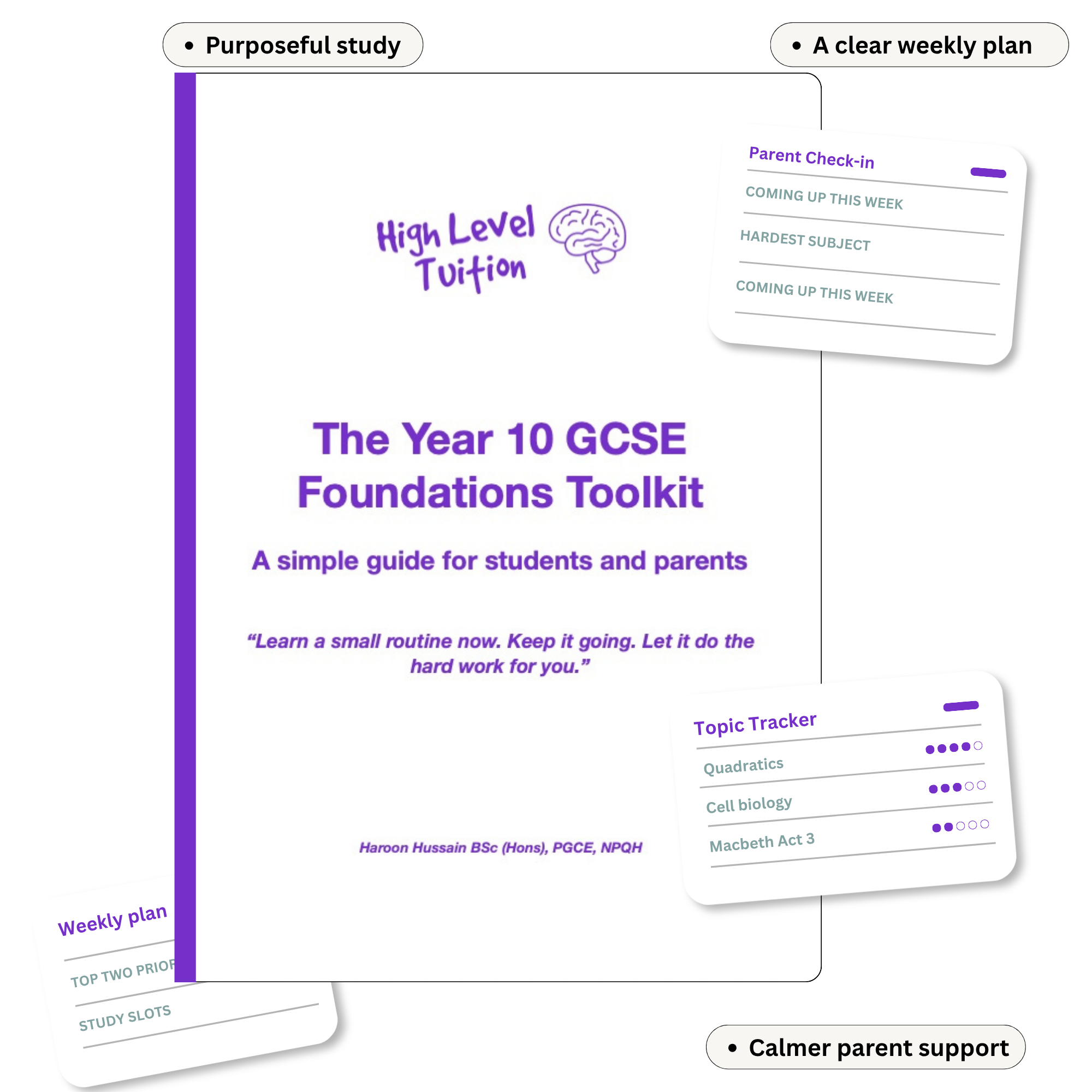
Help your child build GCSE confidence - without turning every evening into revision time.
Help your child build GCSE confidence - without turning every evening into revision time.
Student guide | Eight printable templates | Dedicated parent guidance
A practical toolkit to help Year 10 students get organised, remember what they learn and know what to study next.
You want your child to take their GCSEs seriously.
But you do not want the next two years to become a cycle of reminders, rushed revision and arguments about whether they have done enough.
The Year 10 GCSE Foundations Toolkit gives you both a clearer way forward: small, purposeful study habits, practical planning tools and a calm approach to supporting them at home.
Build the habits now. Give Year 11 a stronger starting point.
Help your child build GCSE confidence - without turning every evening into revision time.
A practical toolkit to help Year 10 students get organised, remember what they learn and know what to study next.
You want your child to take their GCSEs seriously.
But you do not want the next two years to become a cycle of reminders, rushed revision and arguments about whether they have done enough.
The Year 10 GCSE Foundations Toolkit gives you both a clearer way forward: small, purposeful study habits, practical planning tools and a calm approach to supporting them at home.
Student guide | Eight printable templates | Dedicated parent guidance
Build the habits now. Give Year 11 a stronger starting point.


Created by Haroon Hussain, BSc (Hons), PGCE, NPQH — Specialist GCSE Chemistry educator and programme designer.
Designed for real students, living in the real world with real exam pressure.
"A practical approach to helping students organise their study, check their understanding and learn from mistakes."
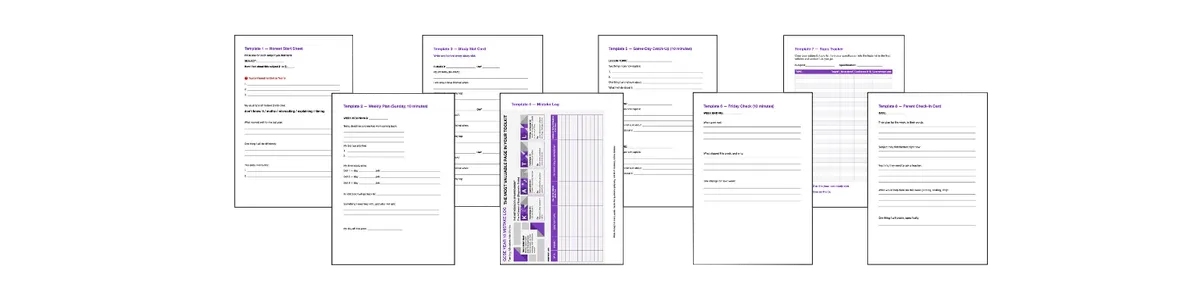
8 PRINTABLE TEMPLATES - INCLUDED WITH THE TOOLKIT
Created by Haroon Hussain, BSc (Hons), PGCE, NPQH — Specialist GCSE Chemistry educator and programme designer.
Designed for real students, living in the real world with real exam pressure.
"A practical approach to helping students organise their study, check their understanding and learn from mistakes."
8 PRINTABLE TEMPLATES - INCLUDED WITH THE TOOLKIT
They’re doing their homework. But is it actually sticking?
Homework gets finished. Notes look tidy. A topic makes sense in the lesson.
Then a test comes back—and you are left wondering why the effort is not showing up in the answers.
"I don’t know what to revise."
"I understand it in class, but forget it in tests."
"How do I help without constantly reminding them?"
You do not need to choose between leaving everything until Year 11 and putting your child under pressure now.
There is a middle ground: help them build a small routine, check their understanding and tackle gaps while those gaps are still manageable.
They’re doing their homework. But is it actually sticking?
Homework gets finished. Notes look tidy. A topic makes sense in the lesson.
Then a test comes back—and you are left wondering why the effort is not showing up in the answers.
"I don’t know what to revise."
"I understand it in class, but forget it in tests."
"How do I help without constantly reminding them?"
You do not need to choose between leaving everything until Year 11 and putting your child under pressure now.
You do not need to choose between leaving everything until Year 11 and putting your child under pressure now.
Meet the Year 10 GCSE Foundations Toolkit
A clearer start to GCSE study.
Not a pile of extra subject notes. Not an impossible revision timetable.
A practical guide that helps students answer three important questions:
01
What should I work on?
Use an honest starting-point review and a Topic Tracker to identify uncertain areas.
02
What should I actually do?
Give each study slot one clear task, then use self-testing, flashcards or practice questions to check understanding.
03
How do I know whether it worked?
Mark the answers, record mistakes and return to them later—rather than measuring progress by time spent at a desk.
For parents, it provides a shared structure for supporting this process without needing to teach every subject.
For parents, it provides a shared structure for supporting this process without needing to teach every subject.
For parents, it provides a shared structure for supporting this process without needing to teach every subject.
Meet the Year 10 GCSE Foundations Toolkit
A clearer start to GCSE study.
Not a pile of extra subject notes. Not an impossible revision timetable.
A practical guide that helps students answer three important questions:
01
What should I work on?
Use an honest starting-point review and a Topic Tracker to identify uncertain areas.
02
What should I actually do?
Give each study slot one clear task, then use self-testing, flashcards or practice questions to check understanding.
03
How do I know whether it worked?
Mark the answers, record mistakes and return to them later—rather than measuring progress by time spent at a desk.
For parents, it provides a shared structure for supporting this process without needing to teach every subject.
Less guesswork.
More purposeful study.
Get organised without the overwhelm
A step-by-step setup plan helps students organise their materials, review earlier difficulties and start a manageable routine.
Know what to study next
Replace vague “I need to revise” intentions with a specific topic and a clear task.
Remember beyond the next test
Learn to use self-testing, active flashcards and short reviews of older topics.
Make mistakes useful
Record what went wrong, decide what to change and revisit questions later.
Build a routine with room for life
Use three study slots, short planning and review activities, and genuine rest.
Get unstuck sooner
Find practical starting points for common problems—and learn when to ask a teacher for help.
Inside the toolkit
More than advice.
Tools they can use this week.
Weekly plan
Topic tracker
Mistake log
Parent check-in
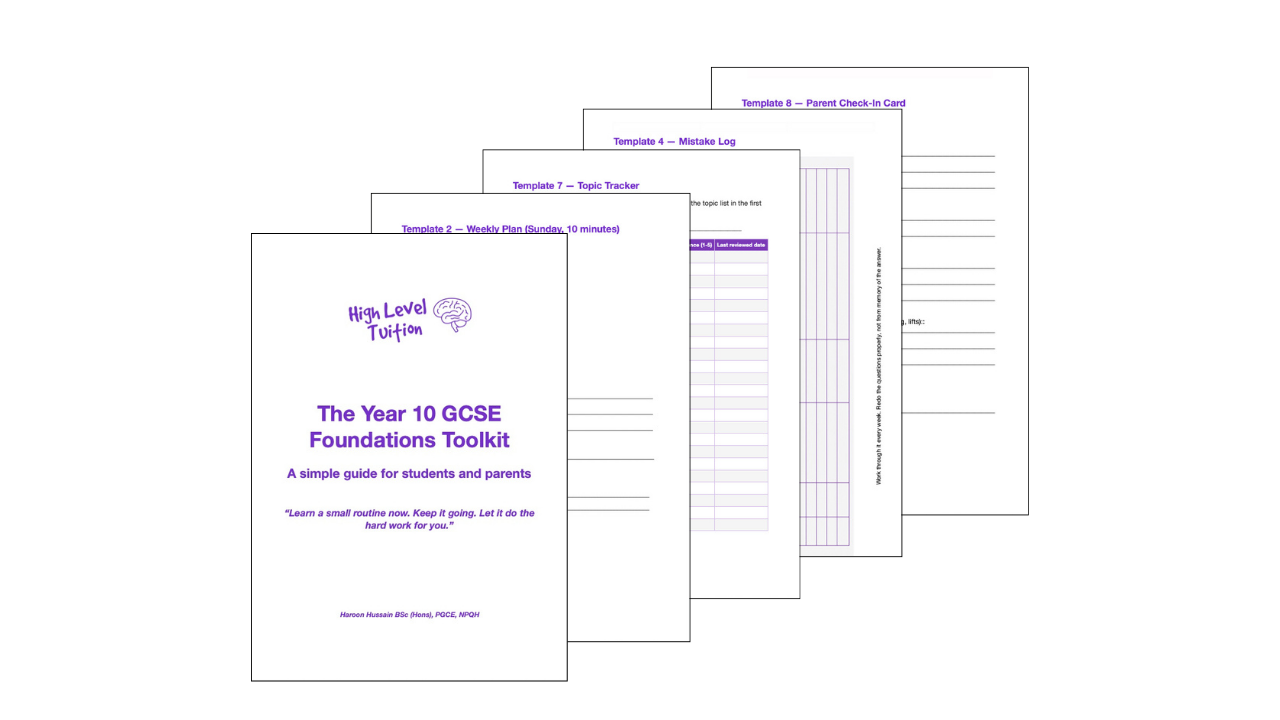
All eight included templates
01 Honest Start Sheet
05 Same Day Catch-Up Sheet
02 Weekly Plan
06 Friday Check
03 Study Slot Card
07 Topic Tracker
04 Mistake Log
08 Parent Check-In Card
01 Honest Start Sheet
05 Same Day Catch-Up Sheet
02 Weekly Plan
06 Friday Check
03 Study Slot Card
07 Topic Tracker
04 Mistake Log
08 Parent Check-In Card
Inside the toolkit
More than advice.
Tools they can use this week.
Weekly plan
Topic tracker
Mistake log
Parent check-in

All eight included templates
01 Honest Start Sheet
02 Weekly Plan
03 Study Slot Card
04 Mistake Log
05 Same Day Catch-Up Sheet
06 Friday Check
07 Topic Tracker
08 Parent Check-In Card
The Parent Guide
You do not need to know the answers to be helpful.
You do not need to relearn algebra, remember every science equation or become an expert in the English texts.
Help your child agree a routine. Make the practical side easier. Ask questions that help them think. Stay calm when something goes wrong.
The dedicated Parent Guide shows you how.
Includes guidance on routines, phone boundaries, flashcard testing, setbacks and when to involve school.
Replace repeated reminders with one useful conversation.
Weekly check-in
1. What is coming up this week?
2. Which subject feels hardest?
3. What are your three study slots for?
4. Is there anything you need to ask a teacher?
5. What would help most from me?
Support their growing independence—without leaving them to figure everything out alone.
A manageable starting point—even if the year is already underway.
You do not have to have started in September. Use the four-week setup sequence from wherever you are now.
WEEK 1
Get organised
Set up subject folders, a calendar, a study space and access to exam specifications.
WEEK 2
Look back honestly
Review previous tests and identify topics and mistakes that need attention.
WEEK 3
Strengthen a foundation
Choose one underlying skill and work through a focused repair session.
WEEK 4
Start the weekly routine
Plan three purposeful study slots, use the templates and review what works.
The goal is not a perfect first month. It is a useful routine you can build on.
A useful next step if…
Your child has started GCSE courses but does not yet have a study routine.
They finish homework but rarely revisit older learning.
They spend time on notes but struggle to answer questions independently.
They do not know which topics to prioritise.
You want to help without daily reminders becoming a source of tension.
You want to build good habits before Year 11.
This is a study and organisation toolkit—not a replacement for lessons or subject-specific teaching.
Questions parents ask
Is this only for students moving from Year 9 into Year 10?
No. The routines and planning tools can be used by students already in Year 10. Begin with an honest review of where they are now. If your child is still in Year 9 and options aren't chosen yet, start with the Year 9 Foundations and Options Toolkit. You can get more information HERE
Does it work across GCSE subjects?
It is a cross-subject study system, with examples relevant to maths, science, English, languages and humanities. It does not contain complete teaching materials for those subjects.
Will this give my child lots of extra work?
The aim is purposeful, manageable study—not filling every evening. The routine uses three study slots alongside short planning, catch-up and review activities. Students can adapt the schedule around school commitments.
Does a parent need to work through every page?
No. Students can work through the main guide, while parents use the dedicated Parent Guide and weekly check-in card. Agreeing the routine together is a useful starting point.
What do I get, and how does it arrive?
Straight after you pay, you'll receive a confirmation email and a link to your Quick Start page. That page has the toolkit download (a digital guide with printable templates you can print as often as you need), your first steps and a short welcome video. Your Guided Implementation Emails start the same day and take you through the toolkit one step at a time.
Does it guarantee a particular grade?
No. It provides a structure for planning, practising and responding to mistakes. Results depend on how it is used, the student’s starting point and the subject support they receive.
You do not need to make Year 10 feel like Year 11.
Help your child build the habits that make the next step less daunting.
Start with a clearer plan. Give each study session a purpose. Help them check what they know, learn from mistakes and ask for support when they need it.
Student guide and four-week setup plan
Repeatable weekly study routine
Revision and troubleshooting guidance
Eight printable planning and tracking templates
Dedicated Parent Guide
What happens after you buy
1. Instant access. Your Quick Start page, toolkit download and a short welcome video from Haroon.
2. Your first step tonight. A 20-minute, no-judgement chat using the Honest Start Sheet.
3. Guided Implementation Emails. Short emails take you through the four-week setup and the first weeks of the routine, then a lighter fortnightly Sunday email keeps it going.
Only
£30
Year 10 GCSE Foundations Toolkit
£30 · one-off payment · instant digital access
Learn a small routine now. Keep it going. Let it do the hard work for you.
You do not need to make Year 10 feel like Year 11.
Help your child build the habits that make the next step less daunting.
Start with a clearer plan. Give each study session a purpose. Help them check what they know, learn from mistakes and ask for support when they need it.
Student guide and four-week setup plan
Repeatable weekly study routine
Revision and troubleshooting guidance
Eight printable planning and tracking templates
Dedicated Parent Guide
What happens after you buy
1. Instant access. Your Quick Start page, toolkit download and a short welcome video from Haroon.
2. Your first step tonight. A 20-minute, no-judgement chat using the Honest Start Sheet.
3. Guided Implementation Emails. Short emails take you through the four-week setup and the first weeks of the routine, then a lighter fortnightly Sunday email keeps it going.
Only
£30
Year 10 GCSE Foundations Toolkit
£30 · one-off payment · instant digital access
Learn a small routine now. Keep it going. Let it do the hard work for you.
Where does this fit in
Part of a four-stage system:
Year 9 choose and practise → Year 10 build the habits → Year 11 run the system → Year 12 run it independently.
See all toolkits ➡

This site is not a part of the Facebook website or Facebook Inc. Additionally, This site is NOT endorsed by Facebook in any way. FACEBOOK is a trademark of FACEBOOK, Inc.
Important: Legal Disclaimers
Results depend on how consistently the toolkit is used. We don't promise specific grades, but we do promise a clear, practical plan and honest guidance..
© Copyright 2026 - High Level Tuition - All Rights Reserved
Terms of Use | Privacy Policy | Support: [email protected]